This post is less about a paper than about a thesis.
Irene López-Mengual came to Türkiye from the University of Alicante in Spain to work on her master's thesis. She stayed in Izmir for about nine months, from September to May. Her supervisor in Alicante was José Luis Sánchez Lizaso, and I was her second supervisor. The topic was recreational rod-and-reel fishing for Atlantic bluefin tuna (Thunnus thynnus), one of the most valuable fish in the Mediterranean. In 2024 Irene, Ali Ulaş and I published the paper that came out of the thesis in the Turkish Journal of Fisheries and Aquatic Sciences.
Where recreational anglers fit into the bluefin story
Bluefin tuna migrate across a huge area stretching from the Atlantic into the Mediterranean, and their stocks are managed by ICCAT (the International Commission for the Conservation of Atlantic Tunas). The Eastern Atlantic and Mediterranean stock was considered overfished for a long time. Abundance rose markedly after the recovery plan, and according to ICCAT's 2022 assessment the stock is no longer overfished.
The commission is still cautious about raising catch quotas. The main reason is illegal and unreported catches, which make it hard to work out how productive the stock really is. Recreational fishing that falls outside the rules, or is not adequately monitored, can also fall under this heading.
Recreational fishing in the Mediterranean is no small matter. According to a 2010 GFCM estimate, more than 10% of the total catch in the Mediterranean came from recreational fishers. There is no newer estimate for the region as a whole, because most recreational catches are still not recorded and are left out of stock assessments. That is why in 2021 the GFCM published a handbook so that countries can collect recreational fisheries data with common methods.
In Türkiye there is no general licence requirement for recreational rod-and-reel fishing. Bluefin tuna is treated separately. Every bluefin caught must be covered by a bluefin tuna catch document (e-BCD) issued by the provincial or district directorate. Under a communiqué published in the Official Gazette on 16 September 2026, recreational and sport fishing for bluefin now also requires a permit, with the procedures to be set by the Ministry. The economics of charter-boat recreational fishing in the Aegean had been studied before, but no study had looked at the effect of recreational bluefin tuna fishing on the stock. Irene's thesis grew out of that gap.
We collected the data from tournaments
During the years covered by the study, two recreational bluefin tuna tournaments stood out in Izmir: Big Fish and Tuna Masters. Boats competed off Çeşme, Teos and Alaçatı. Bluefin come into these waters following schools of small pelagic fish along the coast, and they are also drawn by tuna fattening cages. At the time, the tournament rules were drawn around the cages too: in Tuna Masters boats could not come closer than 400 metres to the cages, and in Big Fish no closer than 200 metres.
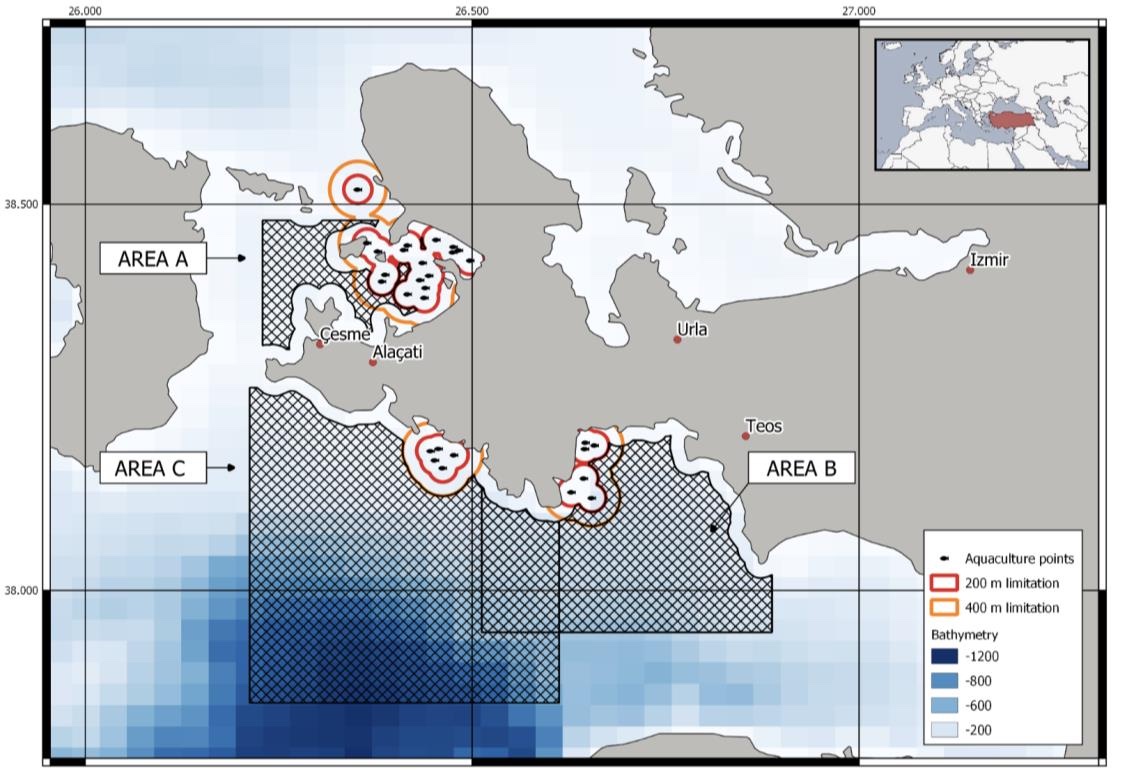
We brought together the logbooks and field surveys from boats that took part in tournaments between 2016 and 2022. That gave us 24 fishing days, about 96 hours of fishing, and 1041 records. Each record shows the total weight of bluefin a boat caught on a given day. In fisheries science this is called catch per unit effort (CPUE). In our study it means the kilograms one boat caught in one day. In the catch-and-release category, fish are only measured for length and released without being weighed, so we calculated their weight from length. We also added sea surface temperature and chlorophyll-a values from satellite data.
None of this would have been possible without the records that tournament organisers and anglers shared with us.
What did we find?
The bluefin caught weighed between 10.45 kg and 305 kg, with an average of around 50 kg. Average catch per boat per day came out at 5.56 kg. The differences between years were large: the lowest value was 2.86 kg per day in 2017 and the highest 13.98 kg per day in 2018. 2018 was also the year with the most scattered values, and the largest bluefin, at 305 kg, was caught that year.
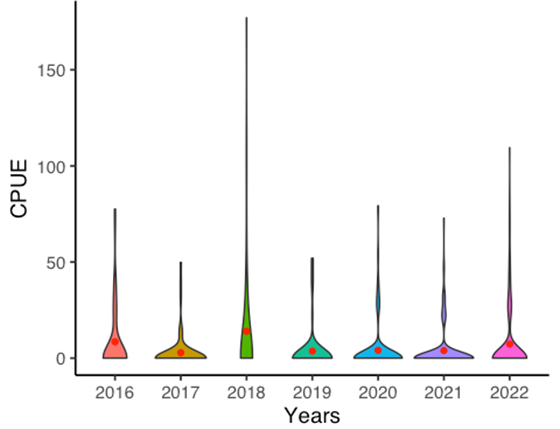
We tested the effects of year, sea surface temperature, chlorophyll-a and location on CPUE together with a generalised additive model (GAM). Year was the only significant variable. Temperature, chlorophyll and location had weak effects. That should not be read as "the environment doesn't matter". Seeing environmental effects clearly takes a longer time series.
When we mapped the model's location effect, catches were higher in the southern part of the study area. The fattening cages in the area may be one of the reasons.
The tournaments have two categories: catch and land, and catch and release. Only 47 of the 1041 records came from catch and release. In recreational bluefin fishing, landing the fish is still by far the most common choice.
Apart from bluefin, we recorded six species as bycatch. By weight, 66.8% of the bycatch (160 kg) was swordfish (Xiphias gladius), followed by albacore (Thunnus alalunga) at 20.5% (49.1 kg). The fish that take the bait are large pelagics similar to bluefin in size and build, so this fishery is quite selective.
What does it mean for management?
In my view, the main message of the study is this: recreational bluefin tournaments are a data source that could contribute to stock assessment and has so far been largely untapped.
This source is growing every year. During our study period there were two tournaments. Today more tournaments are held in Çeşme and Alaçatı, and this year a new one was added at Setur Marina in Çeşme. As long as records are kept consistently, every new tournament means a new data point on bluefin presence along the Aegean coast.
That is why we recommend that tournaments use a common recording format. The new permit requirement for recreational bluefin fishing could be a good basis for such a format. If the number of people on each boat, boat positions, bait type, soak time and number of hooks per boat were recorded, the same tournaments could tell us a lot more. If managers and scientists were involved, collecting maturity data and tagging fish during tournaments would also be possible. The CHART programme in the UK is one example: during the bluefin season, managers and recreational anglers collect catch-and-release and tagging data together.
What comes next?
This study focuses on the tournaments in Izmir. Its results should be seen as local information that complements the general abundance indices for the Mediterranean stock, not as a replacement for them. Recreational bluefin fishing outside tournaments, throughout the year, is still waiting to be studied. These 1041 records are a starting point for monitoring recreational bluefin fishing in Türkiye. As tournaments multiply, the series can be extended.
The full paper is open access: López-Mengual I, Ceyhan T, Ulaş A (2024). Temporal-spatial influences on Atlantic bluefin tuna CPUE in recreational fishery in the Aegean Sea: A generalized additive model approach. Turkish Journal of Fisheries and Aquatic Sciences, 24(10), TRJFAS26100. doi.org/10.4194/TRJFAS26100