We have a new paper out on the blue crab. This time I want to talk not about how the crabs grow, but about how we can catch them more efficiently.
The study came out of the same project as the post where I wrote about the width and weight relationship. I led this project, and it was funded by the Ege University Scientific Research Projects Coordination Unit. We again did the fieldwork at the mouth of Azmak Stream in Seferihisar.
Why pots and bait?
The blue crab is one of the most ecologically and economically damaging invasive species in the Mediterranean. It damages fishers' nets and lowers the quality of their catch. The approach that is spreading across the Mediterranean is to keep the population under control through commercial fishing, together with fishers. In 2022 the GFCM (General Fisheries Commission for the Mediterranean) also launched a regional monitoring programme for the species.
Pots are the most widely used gear in this fishery. If crabs are going to be caught with pots, someone has to decide which pot and which bait to use. In most published comparisons these two effects get mixed up. In one study in Croatia, for example, baited wire pots were compared with unbaited fyke nets. The pots caught far more crabs, but there is no way to tell how much of that difference came from the pot and how much from the bait. We wanted to measure the two separately.
How did we set up the experiment?
We chose two pot types that are easy to buy in Türkiye. The first was a foldable umbrella-type pot that opens to 60-70 cm across and has eight entrance funnels around its edge. The second was a cylindrical double-entrance pot with two opposing funnel entrances. We did not modify either one and used them exactly as a fisher would buy them in a shop.
As bait we tried chicken, fish (fish-processing byproducts and mixed fish flesh) and tripe. Each pot got about 200 grams of a single bait. In every trip we used 12 pots, two for each pot and bait combination.
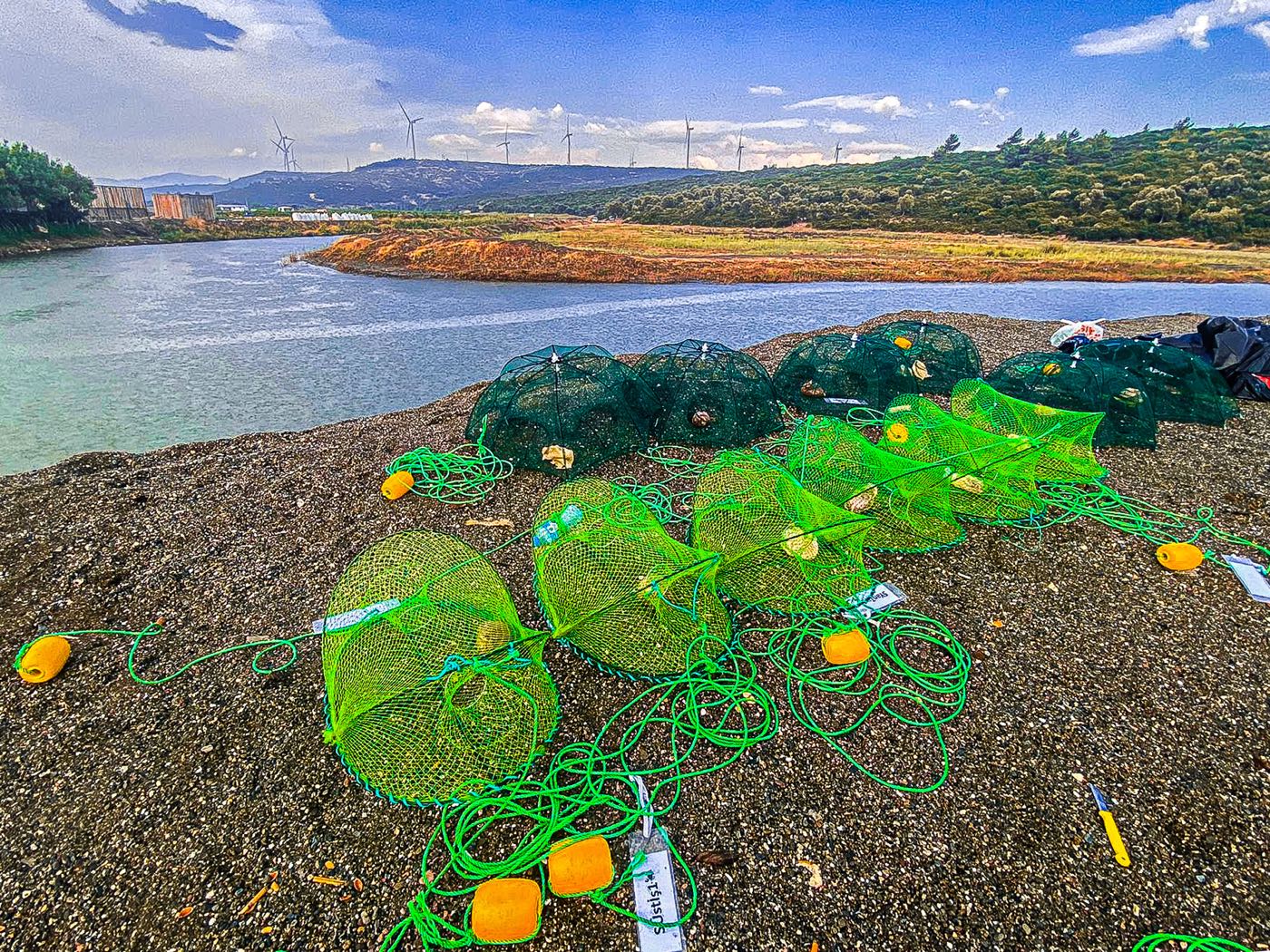
A four-person team baited and prepared the pots on the bank, and then we put them all in the water within about five minutes. That way every pot in a trip started fishing at the same time and under the same conditions. The water was about 60-70 cm deep, and we placed the pots 5-10 metres apart. We changed which pot and which bait went to which spot on every trip, so no combination stayed in the same place.
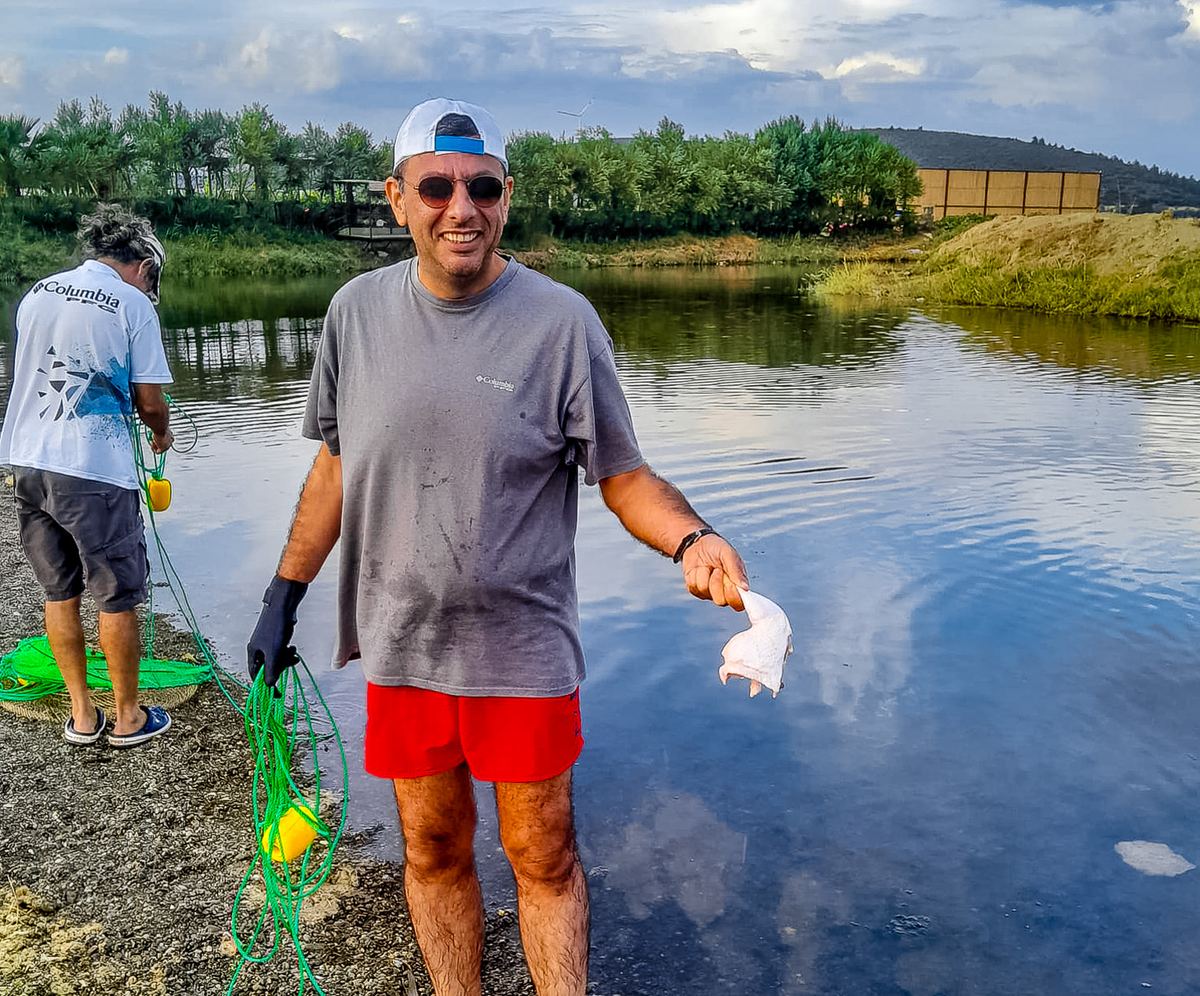
In the first trials we saw that at this site the crabs were most active around dusk. So we left the pots in the water for about two hours in the evening. Between 2023 and 2025 we made 11 trips in total, from June to October.
What did we find?
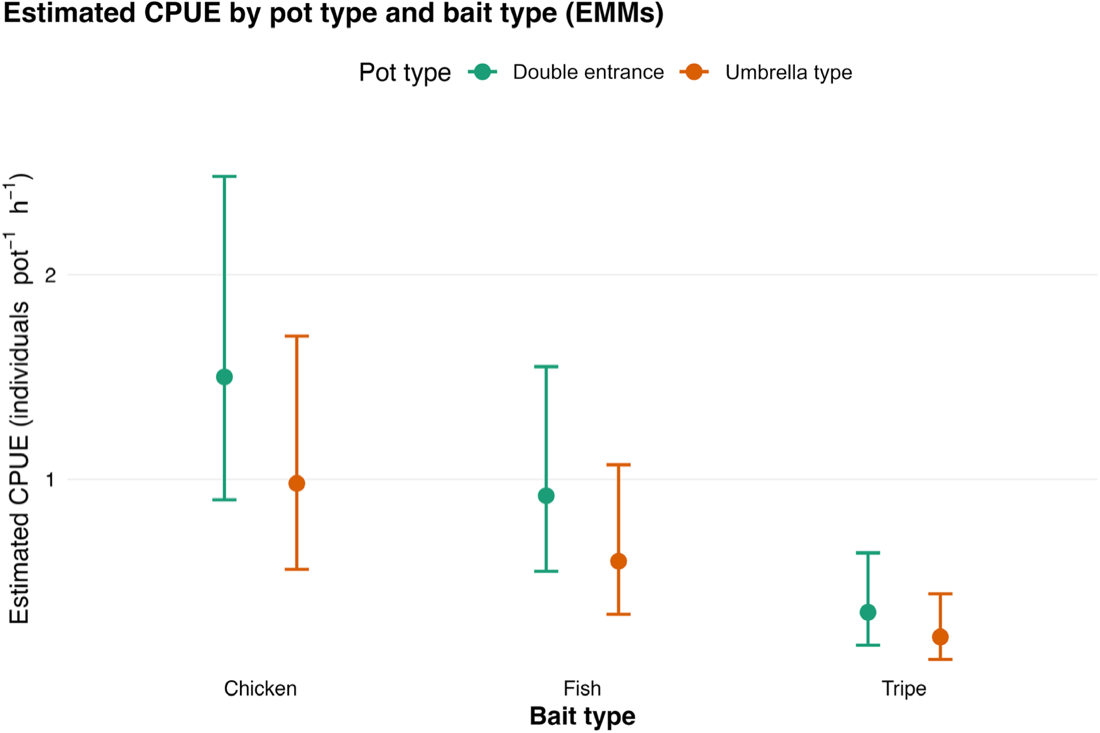
Double-entrance pots caught 1.54 times as many crabs as umbrella-type pots. The difference between baits was even larger. Chicken-baited pots caught 62% more crabs than fish-baited ones. Tripe fell behind even fish, and it was the bait with the most empty pots.
The most efficient combination was the chicken-baited double-entrance pot, which caught about 1.5 crabs per pot per hour. The bait ranking was the same in both pots: chicken first, then fish, and tripe last. In other words, a good bait worked well whichever pot it was used in.
Studies on crab baits show that crabs are very sensitive to amino acids and sugars dissolved in water. The simplest explanation seems to be that chicken releases these substances into the water easily, while tripe releases them more slowly.
The season mattered too. Catch rates were highest in June and fell from July towards October. The lowest values were in September. And no species other than the blue crab entered the pots.
What does it mean for management?
I think the most important result of this study is that the choice of bait is at least as decisive as the choice of pot. For a management programme that aims to reduce the population through fishing, this has concrete consequences. The catch rate directly sets how many pots are needed to remove a given amount of crabs, how much bait has to be sourced, and how much gear stays in the water at risk of being lost over the season.
The seasonal pattern also points to a recommendation. If control fishing is concentrated in the early summer months, when catch rates are highest, more crabs can be removed with the same effort.
But more pots come at a cost. Lost or abandoned pots keep catching animals with nobody hauling them, which is known as "ghost fishing". At our site we also had damaged pots and buoy failures, although we never lost a pot. That is why we recommend that any policy promoting pot fishing for control come with measures to reduce gear loss: marking the pots, recording where and how many pots are set and how many are lost, and retrieving lost pots.
What don't we know yet?
These results show how the crab responds to bait and to pots. But we did not measure the mechanism behind this behaviour directly. Our explanation for why chicken is more attractive rests on other studies of how sensitive crabs are to chemical cues. Experiments that measure which substances baits release into the water, and how fast, could settle this question.
There is a similar question on the pot side. We do not yet know why the crabs entered double-entrance pots more often. A study on the blue swimming crab (Portunus pelagicus) shows that even details such as mesh size or entrance colour can affect how crabs enter a pot. A recent study in the northern Adriatic, with bait and soak time held constant, also found that double-chamber pots performed better. To understand which design feature draws the blue crab into a pot, we need experiments that change these features one at a time.
Our measurements cover only June to October. With these data we cannot say how catch rates change over the rest of the year. So that other researchers can test these questions too, we shared our data and the R code that reproduces every table and figure in the paper's supplementary files.
The full paper: Ceyhan T, Balkı C, Ulaş A, Akyol O, López-Mengual I (2026). Pot type and bait selection shape catch rates of the invasive blue crab (Callinectes sapidus): evidence from a model-based comparative analysis. Marine and Freshwater Research, 77, MF26068. doi.org/10.1071/MF26068